Exploring the World Around Us: A Chemical Engineering Story

Dini Qistina Rashid
December 8, 2025
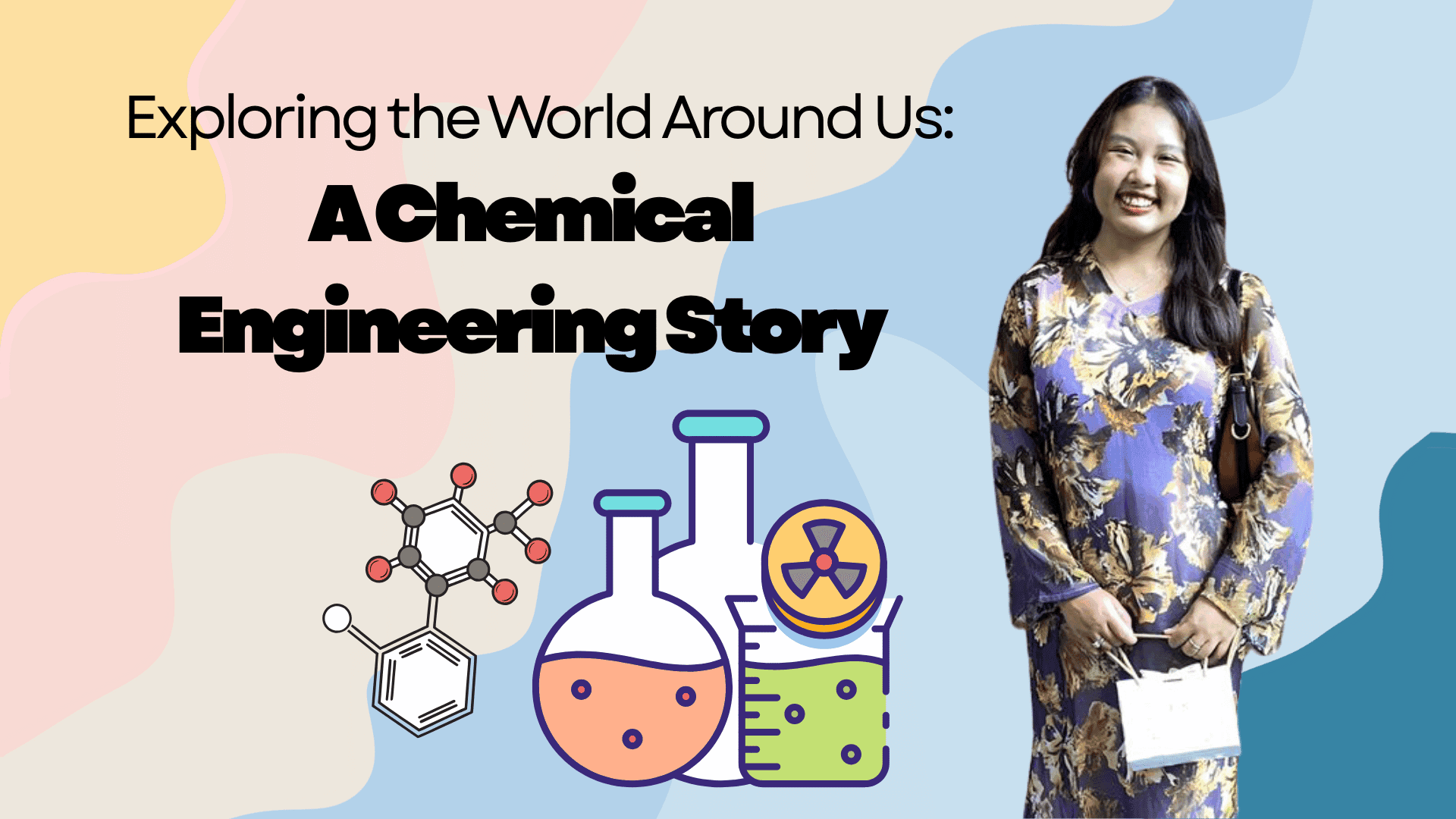
- Chemical engineering starts with wanting to know how everyday things work, and that curiosity becomes the foundation for a wide, flexible career across energy, environment, healthcare, and manufacturing.
- The course is tough, and students face moments of burnout, failure, and pressure. These struggles build resilience, problem-solving, and the ability to think like an engineer.
- Real impact happens after everything comes together. Projects, software skills, internships, and networking prepare you to solve real problems. Graduates like Ainur show how chemical engineers help create cleaner processes, better products, and more sustainable industries.
Chemical engineering often sounds like a mysterious world for SPM leavers. People imagine complicated formulas, huge factories, and engineers staring at screens filled with numbers. But the truth is much more exciting. Chemical engineering is a field where you get to explore every single thing around you. It’s where everyday products like clean water, shampoo, food packaging, batteries, medicine, and even fuel, come from a long chain of careful decisions made by real people.
To understand what this journey looks like in real life, we followed Malaysian Chemical Engineering students from the moment they first felt curious to the moment they stepped into their first professional roles. One of them is Ainur Farissa, a Chemical Engineering graduate of Universiti Teknologi PETRONAS (UTP) who is now an Environment Engineer. Her story shows how chemical engineering can shape the way you think, study, work, and contribute to the world.

Behind the Scenes of Innovation and Impact
For many chemical engineering students, the story did not start with equations. It started with simple questions. Why does a plastic bottle look the way it does? How do factories make safe food? What happens inside a water treatment plant? That spark of wanting to know more is often the real beginning.
Ainur remembers that spark clearly.
“I realised I was always curious about how things around us are made. I liked the idea of understanding what happens behind the scenes,” she said. That curiosity is powerful because chemical engineering sits at the centre of so many industries. Students quickly discover that it connects chemistry, physics, maths, and creative problem-solving into one big playground.
Ainur saw this versatility very early. She explained, “Chemical engineering isn’t limited to one industry or type of problem. It covers energy, environment, materials, healthcare, manufacturing, and much more.”
Chemical engineering is like a passport to a wide range of industries, offering a way to make fundamental, lasting changes across different fields. Whether it's developing eco-friendly materials, designing more efficient water treatment processes, or innovating in energy solutions, the work you do has the potential to touch lives on a global scale. What makes it so appealing is its ability to stay fresh and dynamic, constantly shifting with new challenges and innovations. If you’re drawn to solving complex problems and exploring new frontiers—whether it’s in health, manufacturing, or sustainability—chemical engineering provides the tools and mindset to make a lasting impact. In chemical engineering, the learning never stops, and each breakthrough becomes a step toward a better, more sustainable world.
The First Year Reality Check
The first semester of chemical engineering feels like a whirlwind, a buffet of new subjects coming at you from every direction. You'll dive into physical chemistry, tackle the intricacies of calculus, wrestle with material balances, juggle lab work, and perfect your technical drawing skills. At first, it’s a lot to handle, and the feeling of being overwhelmed is almost unavoidable. But this is the point where everything starts to come together, the moment you begin to think like an engineer.
This early stage teaches more than just theories and formulas. It’s a crash course in mastering time management, taking precise and effective notes, writing concise and clear lab reports, and understanding the critical importance of safety at every step. Above all, you’ll learn how to stay calm and collected when things don’t immediately make sense, because they won’t. But that’s part of the process.
Ainur shared how the course resonated with her mindset. “It aligned perfectly with the way I think,” she said. “I love analysing systems, solving complex problems, and finding practical solutions that can be scaled up. The challenges are real, but so is the satisfaction when you crack the code.”
Chemical engineering isn’t for those who shy away from difficulty. It’s a field that rewards curiosity, persistence, and an analytical mindset. It’s about uncovering patterns in chaos, learning from every mistake, and pushing forward when things get tough. Embrace the challenge, and you’ll find that the rewards—both personal and professional—are more than worth it.
When Things Get Hard
Every chemical engineering student hits a breaking point. The pressure can feel unbearable, with its complex assignments, never-ending quizzes, lab reports, and lengthy tutorials all due at the same time. On top of that, there's the emotional weight of feeling like everyone else has a better grasp of things.
For Ainur, the toughest challenge came during the pandemic. “Studying chemical engineering is hard enough, but doing it all online made everything feel ten times worse,” she recalled. The usual support system, casual chats after class, group study sessions, and friends to share long nights with, vanished. The isolation was intense, and the weight of it all was heavy.
“There were days I woke up feeling completely drained, with no motivation to keep going,” she admitted.
But through the challenging times, she held onto one promise she made to herself: this hardship was temporary, but her goals were lasting. Ainur found small moments of joy in the chaos, adapted to the new reality, and slowly developed a routine that helped her regain her momentum.
Looking back on that challenging period, she shared a lesson that every student needs to hear: “It taught me resilience in a way no textbook ever could.”
Chemical engineering will test your limits, but it’s these very struggles that shape you into someone capable of tackling real-world challenges. The road might be tough, but the lessons you learn along the way will last a lifetime.
The Project That Changes Everything
Every chemical engineering student has that one project that flips a switch in how they view the world. For many, it’s the Plant Design Project: the legendary final year assignment where you design a whole chemical plant from scratch.
For Ainur, it was a game-changer. "It was the first time we had to design an entire process plant from the ground up," she said, remembering the moment when everything she’d learned so far suddenly came together.
This project is like the ultimate test, pushing students to pull together every concept they’ve studied, like reaction pathways, heat exchangers, safety systems, equipment sizing, environmental controls, and even costing. It’s like weaving chemistry and engineering into a single, living, breathing entity.
What surprised Ainur the most was how much goes into making even the most everyday products. "I never realised that something as simple as the detergent we use comes from a maze of decisions, from choosing the right chemicals to determining the perfect mixing process, everything has a purpose," she said. It made her appreciate just how much thought and precision go into creating products we often take for granted.
This is the moment when students realise that chemical engineering isn’t just about solving equations or crunching numbers. It’s about taking responsibility; a plant must never pollute, it can’t explode, and it has to protect the environment and the people around it.
Ainur couldn’t help but laugh as she recalled a running joke in her team: "It’s about designing a plant that won’t explode on the first day of operation."
That perfect mix of fear, excitement, and pride is exactly what makes chemical engineering so thrilling.
Failure That Leads to Growth
Every engineer faces that one subject that almost breaks them. Thermodynamics was the subject for Ainur.
"Learning thermodynamics felt like being thrown into a whole new world," she said. "It was like trying to decode a foreign language." After scoring just 15 out of 100 on a test, it felt like a personal disaster. Staring at the paper, doubts crept in; maybe this wasn't the right path after all.
But instead of giving up, she decided to double down. "Before, I was giving 100%, but after that test, I knew I had to give 500%."
Her approach to studying shifted completely. No longer was she relying on rote memorisation, but understanding the material became the priority. She broke down problems into smaller, manageable steps, asked questions, joined study groups, and watched endless tutorials. Over time, the complex concepts began to make sense.
This experience taught her an invaluable lesson: failure isn't a sign of being incapable, but a signal that your method needs adjustment. Once she fine-tuned her approach, the results changed.
As she puts it: "Failure isn’t the end. It’s just feedback, showing you where you can improve."
Tools That Carry You Through the Heavy Workload
Chemical engineering students rely heavily on industry software, with Aspen HYSYS among the most commonly used tools. Ainur recalled how the software was crucial during her plant design project: "Without it, there wouldn’t even be a project." While students learn the basics in class, true mastery often comes from exploring online tutorials and practising independently. This habit not only helps them ace exams but also prepares them for a workforce increasingly reliant on digital tools.
However, managing academic pressure can be a challenge. Labs, assignments, and reports often stretch late into the night. But good engineers know how to balance their workload with life outside the classroom. Ainur, who initially struggled to juggle everything, eventually realised the importance of prioritisation. "I felt like I was juggling too many things at once," she said. Her breakthrough came when she learned to focus on what mattered at the moment and leaned on her support system. "Balance doesn’t always mean giving equal attention to everything. It means understanding what is important right now." With this mindset, she managed to survive even the busiest weeks without burning out.
Internships, Networking, and Finding Your Place
Internships are more than just a requirement; they shape your entire career. While many students rush to accept the first offer they get, Ainur encourages a more strategic approach. "Accepting the earliest offer isn’t always the best choice," she explained. Researching companies, understanding the department, and asking about the role and what you’ll learn are key. Equally important is networking. Despite being an introvert, Ainur recognised that the people you meet during your career become mentors, references, and even future colleagues. "Don’t underestimate the value of building these relationships."
The Moment Everything Feels Worth It
For every student, graduation day is a moment of triumph, but for Ainur, it was particularly special. "Graduating with a first-class degree made all of my efforts feel worth it," she said. It reminded her that even when the path feels impossible, persistence pays off. Her success became a foundation for future challenges in her career, showing that taking small steps forward can lead to big achievements.
Ainur now works as an Environmental Engineer, with a mission to make industrial processes cleaner and more efficient. "I hope to design processes that reduce waste and emissions," she said. Many young engineers share this vision, as chemical engineering plays a critical role in sustainability. Whether it’s clean water, renewable energy, greener plastics, or waste reduction, chemical engineers are key players in shaping a more sustainable future.
Why Chemical Engineering Might Be Right for You
If you’re an SPM leaver considering chemical engineering, ask yourself if these traits resonate with you:
- A curiosity about how things work.
- A passion for breaking down complex problems.
- A desire for a flexible career with many opportunities.
- A commitment to using technology to benefit people and the planet.
- A preference for hands-on learning that connects science to real-world industry.
Ainur’s journey shows that you don’t need to be perfect to succeed. Curiosity, resilience, strong friendships, adaptability, and the courage to keep going when times are tough are the keys to success. Chemical engineering is not just a degree; it’s a mindset. It teaches you to understand systems, ask the right questions, make informed decisions, and solve problems that impact the world.
One day, you could be the engineer designing a plant to treat your community’s water, reduce carbon emissions, or improve renewable energy efficiency. Your journey can start with a spark of curiosity. The rest is learning, growing, and finding your place in the world, one problem at a time.
Got questions? Click here to chat with one of our counsellors on WhatsApp and get tailored advice!


Students
© 2009 - 2016 Afterschool. All Rights Reserved.